Science has won the iF Design Award 2026 for Product Design in the Medical/Healthcare category for the Axon Terminal, part of the Science Ecosystem.
The honored products are selected by “an independent jury of 129 international leading design and sustainability experts [who] evaluate every project through a rigorous, transparent process. … [in] one of the world’s most coveted competitions for creative excellence,” as outlined on the iF Design website. Science partnered with the design firm Card79 on the project. The awards, recently announced, will be formally presented at a ceremony later this month in Berlin.
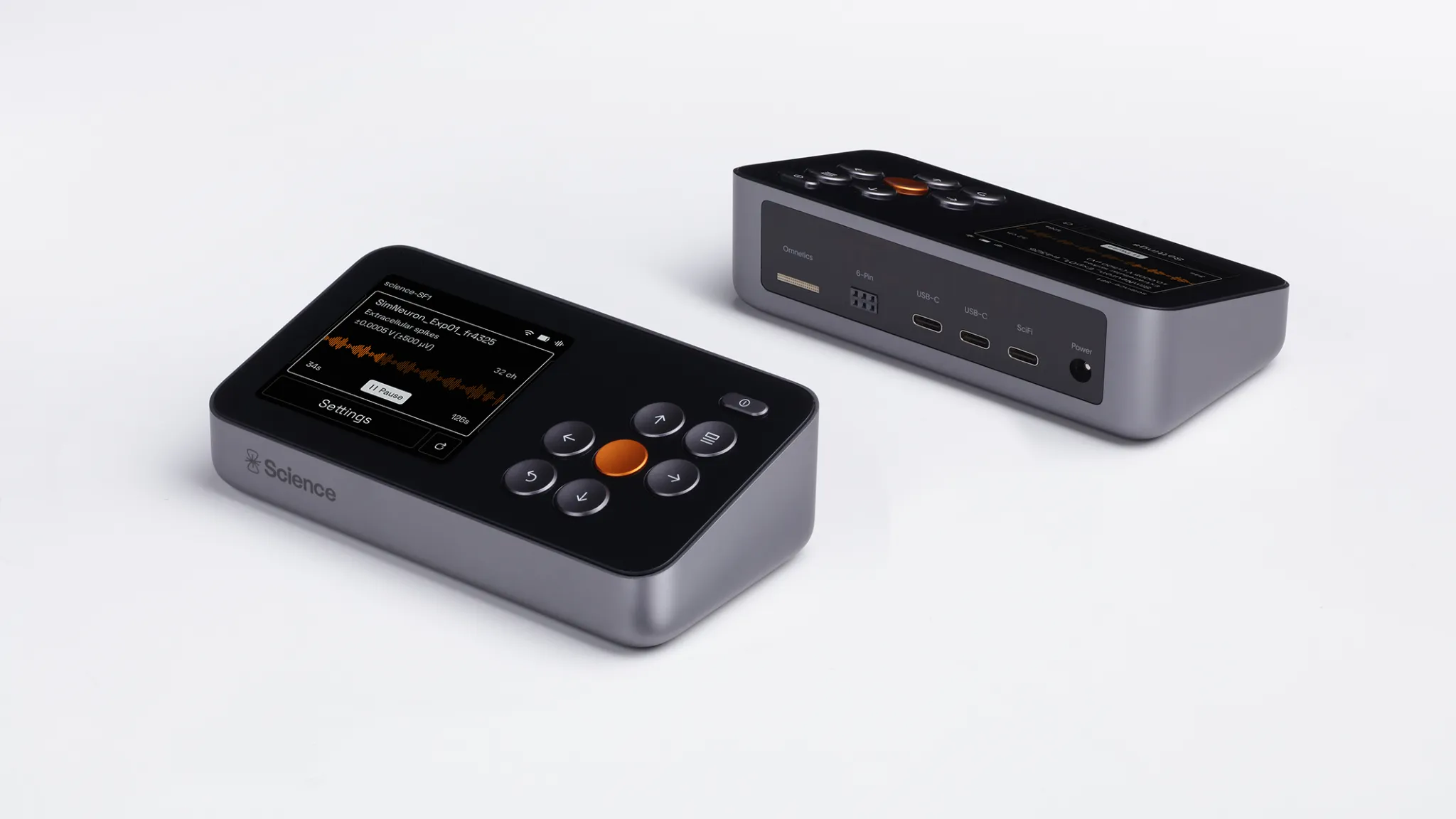
The jury’s citation for the Axon Terminal describes it as:
a portable neural signal simulator, like an “MP3 player for neural data.” It enables researchers to load, browse, and play pre-recorded neural signals, offering a precise yet approachable interface for neuroscience experimentation. Its unique form feels familiar like consumer tech, yet purpose-built for scientific rigor. By uniting ergonomic hardware, clear feedback, and durable construction, the Axon Terminal bridges advanced neural technology with human-centered usability—delivering clarity, comfort, and confidence in every interaction.
Max Rothman, the lead electrical engineer at Science responsible for the project, said: “We wanted to design a research tool that feels just as familiar and intuitive as modern consumer electronics. So we leaned into the concept of an MP3 player as a piece of technology so ubiquitous that someone could pick it up and understand its function almost at a glance.”
The Axon Terminal will be available for sale later this year.
How It Works
Axon Terminal is a neural probe simulator. Neural probes are devices that create the physical connection between the brain and the neural interface system, which can range from metal electrodes to imaging pixels to ultrasound transducers. When a new BCI system is being designed, before it can be used in patients it first must be carefully developed and tested on the bench. Today this is usually an ad-hoc process involving lots of minor custom software, often highly specific to the project and thrown away afterwards. Axon Terminal enables R&D teams to easily test their BCI systems end-to-end with a robust, high quality tool chain, significantly accelerating development velocity.
Far beyond just replaying pre-recorded neural activity or generating random spike trains, Axon Terminal’s system-on-chip allows developers to write sophisticated applications that generate correlated synthetic behavioral and neural activity to fully characterize the behavior of their systems.
